Introduction
We live in an era where technology has become seamlessly interwoven with our daily existence. Artificial intelligence accompanies us through smartphones and tablets, integrating itself into our work, our hobbies, and our personal health care.
The phenomenon that Canadian scientists have termed Hyperconnection describes this unprecedented rise in people-to-people and people-to-machine connectivity, fundamentally reshaping how we interact with the world around us.
Yet amid this digital revolution, there remains a fundamental truth: the first and most essential connection needed for human wellbeing is our connection to nature. This project emerges from a design challenge that seeks to bridge the gap between technology, history, and the natural world. It represents an exploration of how we might reimagine personal mobility as a space for intellectual growth, individual expression, and shared experience.
The Innovators of the Future concept envisions the autonomous vehicle not merely as a means of transportation, but as a mobile sanctuary for knowledge and contemplation. Drawing inspiration from the simple pleasure of reading beneath a tree, this design proposes a radical rethinking of the automotive interior, one that places personal libraries, biophilic elements, and thoughtful spatial design at its core.
Main Objectives
Redefine Personal Space in Autonomous Mobility
The primary objective of this project is to transform the vehicle interior from a transitional space into a destination in itself. By incorporating individual reading libraries and comfortable, expansive seating, the design acknowledges that autonomous vehicles liberate passengers from the task of driving, creating an opportunity to reclaim travel time for personal enrichment.
Balancing Individuality with Togetherness
The concept addresses a nuanced aspect of modern relationships: the desire for shared experiences while maintaining individual identity. Through the example of Caterina and Matt, an intellectual couple with divergent literary preferences, the design demonstrates how two people can occupy the same space while pursuing their unique interests. She gravitates toward fantasy literature; he prefers thrillers. The vehicle provides each with their own curated environment without sacrificing their connection to one another.
Cultural Synthesis and Social Inclusion
A further objective lies in the integration of Korean symbolism with European lifestyle sensibilities. By incorporating Korean color relationships and design philosophy into a context familiar to Western users, the project aims to foster cross-cultural understanding. The aspiration is that social inclusion will emerge naturally when foreign design traditions become part of our daily routines.
Distinctive Elements
The Library as Architectural Feature
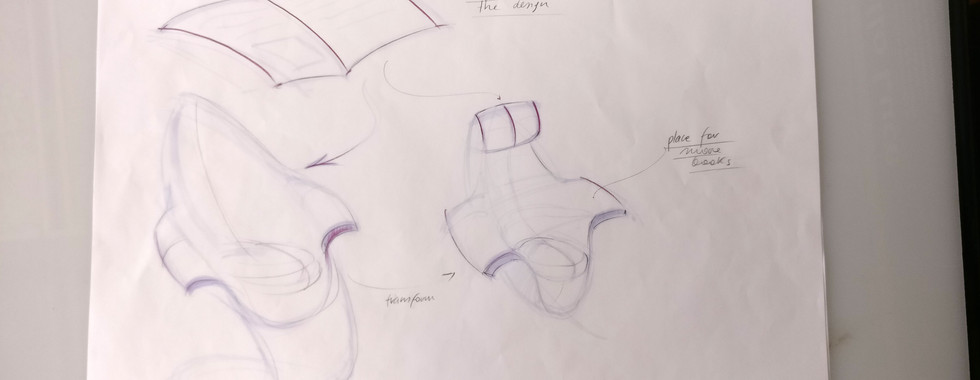
The most striking visual element of the concept is the integration of bookshelves into the vehicle's structure. Individual libraries flank each seating area, with the bottom shelf following the car's flowing lines to create a visual and physical connection between the separate spaces. This architectural approach transforms storage into a design statement, elevating the book from mere object to spatial protagonist.
Biophilic Design Integration
The tree serves as both literal element and symbolic anchor. Positioned as a central biophilic feature, it represents growth, stability, and the essential connection between humans and nature. This is not merely decorative but philosophical: the vehicle becomes a mobile garden, a space where technology and nature achieve harmonious coexistence.
Seat Design Inspired by the Book Form
The seating concept draws direct inspiration from the curved pages of an open book. Understanding that readers prefer wide, comfortable surfaces that accommodate multiple postures, whether leaning, legs crossed, or fully reclined, the seats offer generous proportions and enveloping forms. The chairs feature rotating mechanisms, allowing occupants to enjoy panoramic views while reading or to turn inward toward their personal library space.
Korean Color Philosophy
The color scheme emerges from traditional Korean color relationships, employing White-Metal and Blue-Wood as primary elements. This palette creates a sense of calm sophistication while grounding the design in cultural meaning. The colors interact with the biophilic elements to establish visual coherence between natural and manufactured surfaces.
Interactive Technology Integration
Each personal space incorporates an interactive screen positioned on a single table surface. These screens facilitate the reading of e-books and e-journals while also accommodating video content. The approach to technology follows the principle of deconnection, using the prefix to indicate a natural, clean approach to technology. Wide windows complement the screens, ensuring passengers remain connected to the world beyond the vehicle.
Considerations
Material Innovation and Sustainability
The realization of this concept depends upon emerging smart materials. Aerogels offer exceptional insulation with minimal weight. Thermochromic, electrochromic, and photochromic materials enable responsive surfaces that adapt to changing conditions. Laboratory-developed biofibers promise to bring natural aesthetics without requiring environmental destruction. These materials are not mere technical considerations but fundamental enablers of the design philosophy.
The Tension Between Hyper and De
The design navigates a productive tension between hyperconnection and deconnection. The prefix hyper, from the Greek hupér meaning over, implies exaggeration and intensity. The interior employs extremely detailed technology, yet this sophistication is balanced by the opposite impulse: a natural, uncluttered approach that allows technology to recede into the background when desired.
Future-Proofing the Design
The inclusion of more open spaces within vehicles and the emphasis on individuality represent a forward-looking approach to automotive design. As autonomous technology matures, the interior becomes the primary differentiator between vehicles. By centering personal and interpersonal connection, rather than mere transportation efficiency, this design positions itself for a future where vehicles serve as extensions of our living spaces.
Practical Challenges
Any concept of this ambition must acknowledge practical constraints. The integration of living plants requires careful consideration of light, water, and climate control. Books, while culturally significant, present weight and safety considerations. The generous seating proportions challenge conventional vehicle packaging. These challenges are not insurmountable but demand continued design refinement and engineering collaboration.
Conclusions
The Innovators of the Future concept represents more than a vehicle design; it embodies a philosophy of mobility that honors both progress and tradition. In an age of hyperconnection, it proposes that our most meaningful innovations may be those that reconnect us with timeless human pleasures: reading, contemplation, the presence of nature, and the company of loved ones who respect our individuality.
The design demonstrates that luxury in the future will not be defined by speed or ostentation, but by the quality of experience and the opportunity for personal growth. A vehicle that provides space for hundreds of books, a view of the passing landscape, and the gentle presence of living plants offers a form of wealth that transcends material possession.
By weaving Korean design philosophy into a European lifestyle context, the project suggests that the vehicles of tomorrow will be global in their references and local in their adaptability. Social inclusion emerges not through homogenization but through the thoughtful integration of diverse cultural perspectives.
Ultimately, this concept invites us to imagine travel time not as lost hours but as found moments. The autonomous vehicle, freed from the demands of operation, becomes a mobile study, a garden on wheels, a shared space for individual dreams. In designing for the innovators of the future, we are perhaps designing for the readers, the thinkers, and the dreamers who have always been with us, waiting for technology to create spaces worthy of their aspirations.
• • •
New Thinking. New Possibilities.